

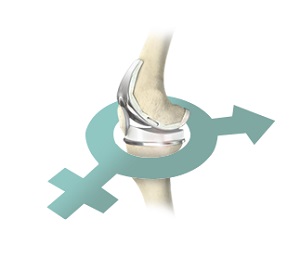
What is Gender-Specific Knee Replacement?
Gender-specific knee replacement, also known as woman’s knee replacement, is a surgical procedure in which gender-specific knee implants specifically designed for a male or female are used for total knee replacement surgery. The prosthesis is designed in such a way that it matches the specific knee anatomy of the male or female gender, as universal knee replacement implants may not be suitable for all men or women due to anatomical differences.
What is the Knee Joint Comprised Of?
The knee is made up of the femur (thighbone), the tibia (shinbone), and the patella (kneecap). The lower end of the thighbone meets the upper end of the shinbone at the knee joint. A small disc of bone called the patella (kneecap) rests on a groove on the front side of the femoral end. A bone of the lower leg (fibula) forms a joint with the shinbone. The bones are held together by protective tissues, ligaments, tendons, and muscles. Synovial fluid within the joint aids in the smooth movement of the bones over one another. The meniscus, a soft crescent-shaped area of cartilage between the femur and tibia, serves as a cushion and helps absorb shock during motion.
What are the Indications for Gender-Specific Knee replacement?
The most common condition requiring a knee replacement is arthritis which is more common in women than men. It is a condition in which the cartilage slowly wears away eventually leading to painful bone on bone movement. Indications for gender-specific knee replacement include:
- Severe osteoarthritis of the knee joint
- Rheumatoid arthritis/inflammatory arthritis
- Knee deformity with loss of cartilage and pain
- Instability of the knee
- Wear and tear of cartilage due to overuse or advanced age
- Severe injury or fracture of the knee
- Significant pain, swelling, and stiffness affecting mobility and quality of life
- Failure of conservative treatment measures
What are the Key Features of Gender-Specific Knee Replacement?
- The implant is very thin so the knee will feel more natural.
- The angle between the kneecap and the patella is 7 degrees, whereas it is 0 degrees in a non-gender-specific implant
- This is designed to fit the unique shape of the female knee.
What is the Procedure for Gender-Specific Knee Replacement?
The general procedure involved in gender-specific knee replacement includes:
- Your doctor will administer general or regional anesthesia.
- A small incision will be made on the surface of the knee.
- Your doctor will then remove the damaged part of the knee joint.
- The gender-specific knee implant will be then introduced.
- The implants will be fixed at the end of the bone using screws and plates for stabilization.
- Your doctor will then place an articular surface in between the implants to ensure the smooth movement of the knee.
- The whole joint is then cleaned with a sterile solution and the incision is closed.
What Does Postoperative Care for Gender-Specific Knee Replacement Involve?
In general, postoperative care instructions and recovery will involve the following steps:
- You may notice pain, swelling, and discomfort in the knee area. Medications will be provided as needed.
- Antibiotics may also be prescribed to address the risk of surgery-related infection.
- Keep the surgical site clean and dry. Instructions on surgical site care and bathing will be provided.
- You will be placed on crutches for the first few weeks with instructions on restricted weight-bearing. You are encouraged to walk with assistance as frequently as possible to prevent blood clots.
- Use of a continuous passive motion machine (CPM) at home is advised during the first few weeks to aid in the constant movement of the knee joint under a controlled range of motion.
- You are advised to keep your leg elevated while resting to prevent swelling and pain.
- Refrain from smoking as it can negatively impact the healing process.
- Eating a healthy diet rich in vitamin D is strongly advised to promote healing and a faster recovery.
- Refrain from strenuous activities and lifting heavy weights for the first couple of months. Gradual increase in activities over a period of time is recommended.
- An individualized physical therapy protocol is designed to help strengthen your knee muscles and optimize knee function.
- You will be able to resume your normal activities in a couple of months; however, return to sports may take 4 to 6 months.
- A periodic follow-up appointment will be scheduled to monitor your progress.
What are the Benefits of Gender-Specific Knee Replacement?
Some of the benefits of gender-specific knee replacement include:
- Unique shape: This implant has a unique shape and size that helps differs from other knee implants. It is very thin and helps in the natural movement of the knee.
- Better function: This gender-specific implant replicates the normal knee anatomy of women, improving durability and function.
- Faster recovery: Gender-specific knee replacement provides faster recovery with high flexion.
What are the Risks and Complications of Gender-Specific Knee Replacement?
Gender-specific knee replacement is a relatively safe procedure; however, as with any procedure, it does carry some risks, including:
- Blood clots
- Infection
- Bleeding
- Injury to nerves and blood vessels
- Persistent pain and stiffness
- Implant-loosening
- The need for revision surgery (to address a faulty or problematic implant)
For more information about our services or to schedule an appointment, call us at or clnodisplayick here to request an appointment online. We’ll respond to you as soon as possible.